About the Project
Did you know that the current waste charge doesn't just cover household kerbside bin collection?
It also covers the costs associated with waste & recycling bins at community locations, illegal rubbish collection, landfill rehabilitation and other waste-related services.
This charge currently applies to approximately ~30,000 rateable properties that receive the Council kerbside bin service, while approximately ~4,000 rateable properties that do not receive Council's kerbside bin collection do not contribute to the current waste charge.
Council is exploring whether there is a more transparent and equitable way to distribute these costs through a split charge approach.
The proposed Waste Collection Charge would apply to properties receiving or eligible to receive, Council kerbside waste collection services.
The charge would be based on the direct and attributable costs of providing those services, subject to confirmation of the eligible cost base under section 162 and the Minister’s Good Practice Guidelines for Service Rates and Charges.
- Kerbside landfill/general waste collection.
- Kerbside recycling collection.
- Food organics and garden organics collection, where provided.
- Glass collection, where provided.
- Bin supply, replacement, repair and maintenance.
- Transport, processing and disposal of kerbside waste streams.
- Landfill levy costs attributable to kerbside waste.
- Kerbside contamination management and service-specific education.
- Direct contract management and administration associated with kerbside services.
The proposed Municipal Waste Charge would recover eligible costs associated with community-wide waste, recycling and waste-management services that are not directly attributable to an individual property's kerbside collection service.
The charge would apply broadly across all rateable properties, or other defined property classes, recognising that these services provide a broader community benefit rather than a property-specific service.
Services for consideration include:
- Public-place bins – installation, collection, servicing and general waste disposal.
- Street litter bin services – installation, collection, servicing, waste and recycling disposal, including cleaning and maintenance of associated bin enclosures.
- Illegal dumping prevention, response and clean-up on Council-managed land.
- Green waste amnesty periods.
- Transfer station and resource recovery facilities.
- Ongoing aftercare and environmental management of closed landfills.
- Other waste, recycling or resource recovery services that provide a community-wide service benefit.
Further assessment will be undertaken to determine whether the associated costs are appropriately recoverable through a service charge under section 162 of the Local Government Act 1989 and the Minister’s Good Practice Guidelines for Service Rates and Charges.
Waste Charge – 2026–27
Disclaimer – Waste Charge Cost Allocation
The table below shows a high-level estimate of the allocation of waste service costs and income between the Kerbside Collection Charge and the Municipal Waste Service Charge.
- It takes into account the proposed cost-recovery methodology using 2026–27 budget estimates.
- Income has been attributed to the charge associated with the activity or service that generates the income.
- Where an income stream relates to more than one waste service, an appropriate allocation methodology or cost driver will be applied.
- The allocation of project recoveries, administrative overheads and shared waste service costs remains subject to further review and validation to ensure that costs are allocated appropriately and consistently with the services to which they relate.
- The total allocation across the two charges will amount to the approved net cost of providing Waste Services.
The proposed charges are therefore only indicative for modelling and budget purposes and will be adjusted following validation of the underlying cost and income allocations, final project expenditure, operational requirements and applicable cost-recovery requirements.
| Waste service cost | 2026–27 Budget Recoveries $’000 | 2026-27 Budget Expenditure $’000 | Kerbside Collection $’000 | Municipal Waste Service $’000 |
| Environmental Aftercare & Compliance | 557 | 557 | 0 | 557 |
| Waste Service Delivery Incl. Transfer Stations | 4,578 | 4,578 | 0 | 4,578 |
| Landfill levies | 1,792 | 1,792 | 1,000 | 792 |
| Public Place & Street litter Waste Collection | 1,188 | 1,188 | 0 | 1,188 |
| Kerbside Recycling Costs (yellow bin) | 2,925 | 2,925 | 2,925 | 0 |
| Kerbside Landfill (red bin) | 1,969 | 1,969 | 1,969 | 0 |
| Kerbside Organics (green bin) | 4,549 | 4,549 | 4,549 | 0 |
| Total budgeted expenditure | 17,559 | 17,559 | 10,444 | 7,115 |
| Project recoveries (active and legacy landfill rehabilitation, new cells etc.) | 4,004 | 4,621 | 1,987 | 2,634 |
| Subtotal incl. projects | 21,563 | 22,180 | 12,431 | 9,748 |
| Administrative overheads | 2,695 | 2,695 | 1,379 | 1,317 |
| Total cost | 24,259 | 24,875 | 13,810 | 11,065 |
| Less attributable income (gate fees, scrap metal other recycled material) | -3,742 | -3,742 | -540 | -3,202 |
| Total cost | 20,517 | 21,133 | 13,270 | 7,863 |
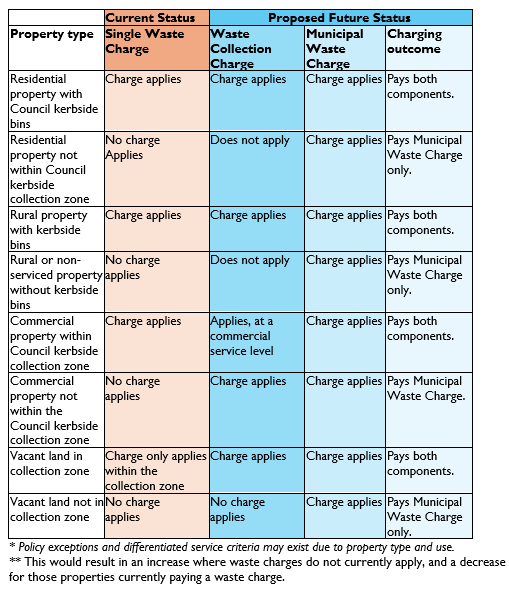
Under this model rateable properties that receive kerbside waste collection will pay both charges. Properties that don't receive Council's kerbside waste collection will only pay the Municipal Waste Charge.
The proposal is not about increasing the amount collected through the waste charge but about dividing it fairly among everyone who benefits from the services the charges pay for.
This would likely result in an increase for properties that do not current pay a waste charge, and a decrease for those who currently do pay a waste charge.
The proposal to split the funds recovered for the Waste Service into two-parts would result in the cost burden being shared amongst a greater number of rateable properties.
Under the two-part charge approach, approximately 34,000 rateable properties would contribute to the Municipal Waste Charge, and 30,000 properties contribute to the Waste Collection Charge. This is an approximate 4,000 additional properties contributing to a portion of the total Waste Charge (Municipal Waste Charge and Waste Collection Charge).
This means approximately 4,000 additional properties would contribute to part of the overall Waste Service cost. As a result, the amount recovered from the 30,000 properties currently contributing to the Waste Service would reduce.
This roughly equates to 1:7 ratio. In practice, this means for every $7 recovered from the additional 4,000 properties through the Municipal Waste Charge it would result in a $1 reduction in the Kerbside Collection Charge for the remaining 30,000 properties.
As an illustrative example only*, if the total cost of the Waste Service was $20 million with:
- $7 million required to fund the Municipal Waste requirements; and
- $13 million for the Kerbside Waste Collection,
it would result in the following changes:
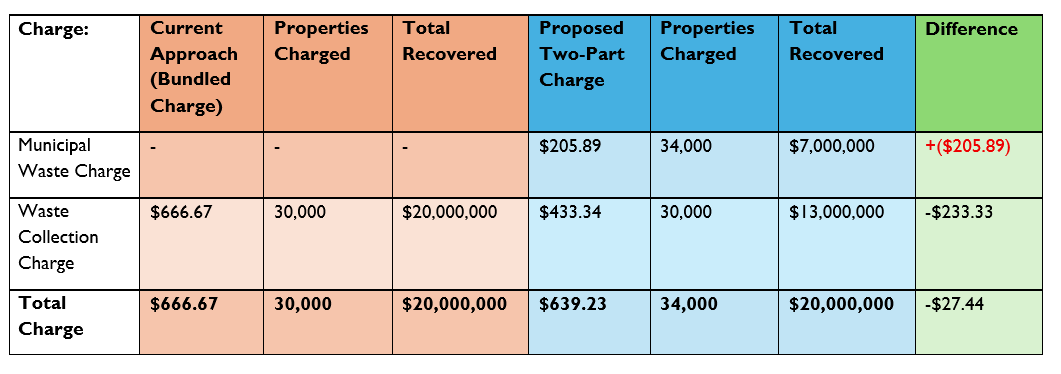
*This is an illustrative example only. Exact charges and the allocation of costs between the two components would be determined as part of the 2027-28 Budget Development process, following community feedback.
Under this illustrative example, the approximately 30,000 properties currently contributing to the Waste Service would pay $27.44 less in total Waste Service charges, reducing from $666.67 to $639.23.
The approximately 4,000 additional properties that would contribute to the Municipal Waste Charge would pay $205.89 towards the Municipal Waste component.
The example demonstrated how separating the Waste Service charge into two components would change how the total cost of the service is distributed across rateable properties, while the amount recovered for the Waste Service remains $20 million (in this example).
The review aims to:
- Improve transparency and fairness in how waste charges are distributed
- Improving equity between kerbside and non-kerbside properties
- Clearly distinguish between kerbside collection services and community-wide waste services
- Better align with how other Council’s distribute the charges
To provide feedback complete the survey below or come along to one of the drop-in sessions around the Shire to speak directly with staff. Have a question? Let us know in the Q&A box below and we'll get back to you with a response.
If you would prefer to submit a written response - please email to basscoast@basscoast.vic.gov.au or mail to PO Box 118 Wonthaggi VIC 3995.
This review is solely about how the costs of eligible waste services are distributed — not about changing the waste service itself.
Survey
Drop-in sessions
Come along to one of the drop-in sessions to ask questions and provide any feedback you have about the proposed two-part charge.
Monday 21 September - Cowes
12:30pm-2pm, Berninneit
Thursday 24 September - Newhaven
5pm-6:30pm, Phillip Island Visitor Information Centre
Monday 28 September - Online
6pm-7:30pm, online - register here for the link
Tuesday 29 September - Grantville
1pm-2:30pm, Grantville Recreation Reserve
Friday 2 October - Inverloch
12:30pm-2pm, Inverloch Hub Community Room
Saturday 3 October - Wonthaggi
10:30am-12pm, Wonthaggi Town Hall
Tuesday 6 October - Online
9:30am-11am, online - register here for the link
Tuesday 6 October - Krowera
5:30pm-7pm, Krowera Community Hall
Wednesday 14 October - Online
5pm-6:30pm, online - register here for the link
Friday 23 October - Wonthaggi
12pm-1:30pm, Wonthaggi Town Hall
Monday 26 October - Coronet Bay
5pm-6:30pm, Coronet Bay Community Hall
Tuesday 27 October - Newhaven
5pm-6:30pm, Newhaven Visitor Information Centre
Q&A
Have a question?
To ask a question you must create an account or log in.
These are the people that are listening and responding to your questions.
Manager Financial Services
Manager Financial Services
Coordinator Waste Services
Coordinator Waste Services
{{question.description}}