About the Project
The Council's Urban Roads and Drainage Improvement Program has helped improve infrastructure in Bass Coast for many years.
These upgrades are usually delivered through Special Charge Schemes. This is a way for Council to raise money for an upgrade project by charging property owners that benefit from the upgrade. This is allowed by the Local Government Act 1989.
This process means many communities now have better infrastructure like sealed roads, kerbs, footpaths, drainage, and other important facilities. The Council also helps pay for these projects if they benefit the wider community, not just the upgraded area.
The project to upgrade the streets of Jam Jerrup was started in response to a petition to the Council that was received in September 2024. The petition showed that 55% of property owners in Jam Jerrup want a road and drainage upgrade to occur and are willing to help pay for it.
What might it look like?
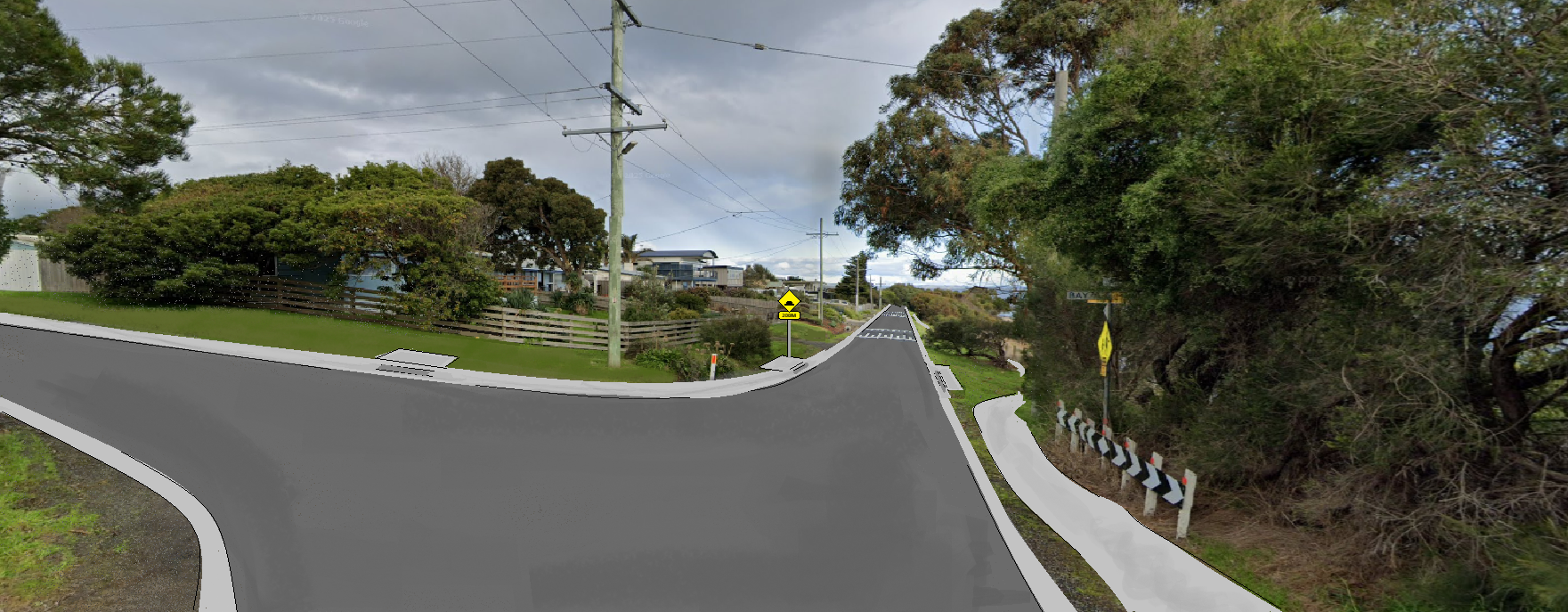
Image depicts example of upgrade including road sealing, underground drainage, footpath and traffic calming

How is cost determined?
The cost of a Special Charge Scheme is shared between Council and the property owners who directly benefit from the upgrade.
Costs are split based on a benefit ratio.
The benefit ratio is a calculation of the benefits received by the properties within the special charge scheme compared to benefits received by the wider community. Council contributes financially towards the benefits received by the wider community.
The benefit ratio is calculated using traffic count data, parking surveys and census information.
Property owner costs
The total contribution amount to be paid by property owners within the scheme area is shared to each property based on various factors such as boundary length (road costs) and property area (drainage costs). Properties that have a large area or property boundary length are capped to ensure costs are fair and reflective of the benefits received by property owners.
Costs relating to any road upgrades are traditionally determined by sharing 75% of costs equally amongst all property owners and sharing the other 25% based on individual property boundary lengths. Costs relating to any drainage upgrades are traditionally split based on property size.
Once a preferred concept design is determined, property owners will be presented with their properties estimated contribution amount (special charge) and will be able to formally support or object to the proposed costings through the formal legislative process.
What happens next
The responses from property owners will help Council create a preferred design. Once completed, final costings will be determined and presented to property owners through the formal legislative process.
Council must follow the special charge scheme process under the Local Government Act 1989. These steps ensure property owners can formally support or object to the project, and that the process is fair and transparent.
Intention to Declare
A Council report outlining the proposed works, costs and supporting documents will be presented at a Council meeting. This begins the formal statutory process.
Community submissions and/or objections
Property owners and community stakeholders can support or object to the proposed scheme. Submissions must be made by the specified date (generally 2 months after the Intention to Declare).
Property owners will be notified of their right to make a submission and how to do so. Correspondence is sent via hardcopy and email using Council’s database.
Property owners may also request to be heard in person by Councillors through the Committee of Council.
Declaration or abandonment (decision)
As required by legislation, Council must abandon a scheme if more than 50% of objections are received, unless Council’s contribution is greater than one third of the total cost (note: Jam Jerrup is unlikely to have a contribution over one third).
If fewer than 50% objections are received, Council can declare the project.
Council officers will then begin detailed design and preparation for construction, including permit applications, Cultural Heritage Management Plans (CHMP) and Flora and Fauna studies. On‑ground construction is generally completed within 2 years.
As per legislation, property owners must be invoiced for their contribution within 12 months of declaration. Repayment options, including interest rates, will be outlined in the initial invoice. Please see the Frequently Asked Questions for details on repayment options and financial hardship.
All special charge scheme projects are subject to Council approval.